Property ownership is one of the most valuable legal and financial rights a person can hold. However, confusion often arises around terms like title, deed, and title deed. Many property disputes, rejected loans, and legal complications happen simply because buyers do not understand these concepts clearly.
What Is a Title Deed of Property?
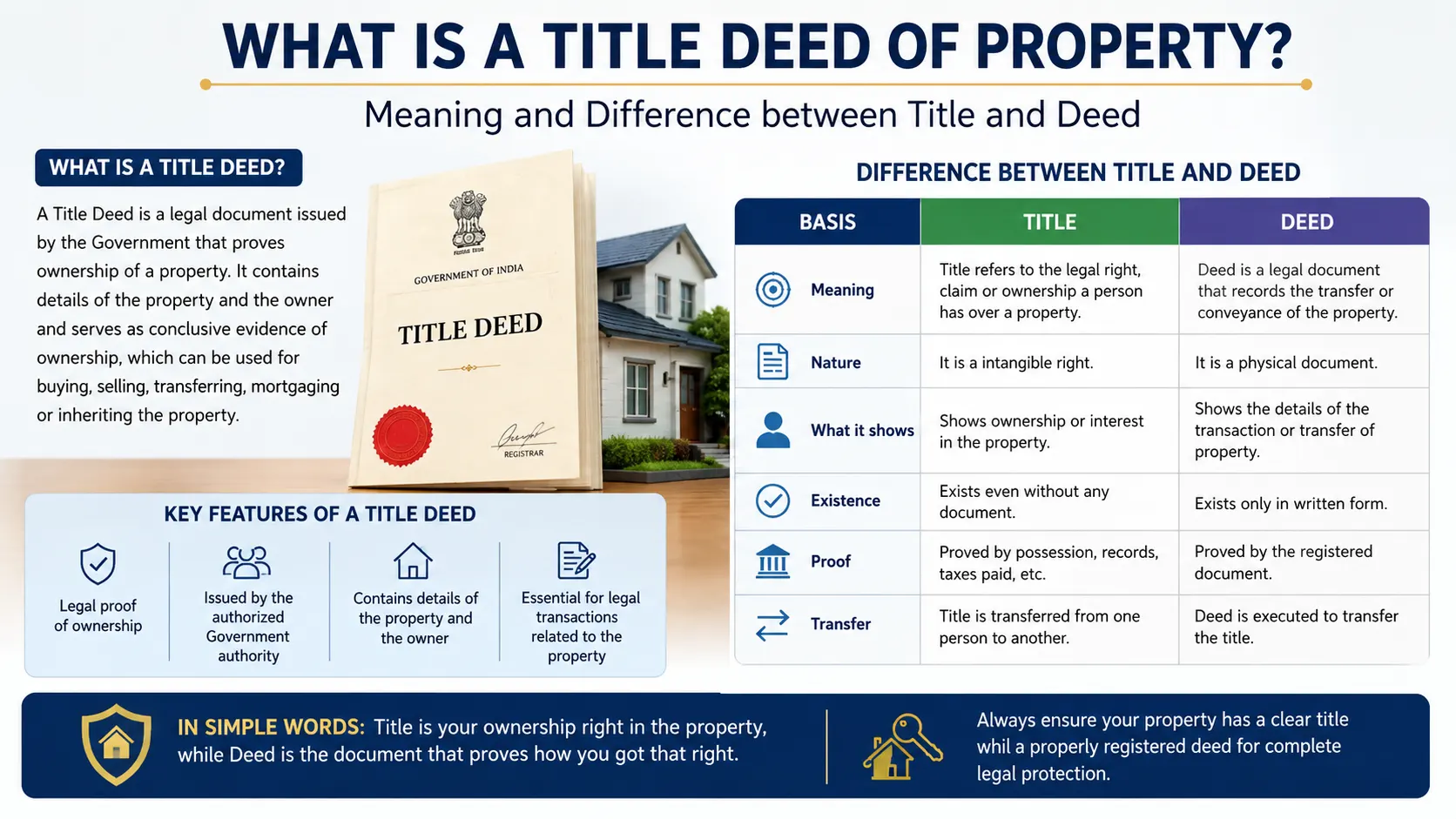
A title deed of property is a legal document that proves ownership of a property.
It establishes who owns the property, how ownership was acquired, and whether the ownership is legally valid.
In simple terms:
A title deed is the legal proof that a property belongs to a specific person or entity. Without a valid title deed, ownership can be disputed, challenged, or rejected by courts, banks, and government authorities.
Meaning of “Title” in Property Law
A title refers to the legal right of ownership over a property.
Key Characteristics of Title
- It is a legal concept, not a document
- It represents ownership rights
- It may be clear, defective, or disputed
What Is a Clear Title?
A property is said to have a clear title when:
- The owner has lawful ownership
- There are no disputes or court cases
- No unpaid loans or third-party claims exist
- The chain of ownership is legally valid
A clear title is essential for buying, selling, or mortgaging property.
Meaning of “Deed” in Property Law
A deed is a written legal document that records or transfers rights related to property.
Key Features of a Deed
- It is executed between parties
- It is signed, stamped, and registered
- It serves as evidence of a transaction
A deed becomes legally effective only when executed according to law and, in most cases, registered.
What Is a Title Deed?
A title deed is the documentary evidence of ownership.
When a deed legally transfers ownership and is properly registered, it becomes a title deed.
In other words:
- Title = Ownership right
- Deed = Legal document
- Title Deed = Document proving ownership right
Types of Title Deeds in Property Law
Depending on how ownership is acquired, there are different types of title deeds. Each type has its own legal significance.
1. Sale Deed
A Sale Deed is the most common and strongest title deed.
- Used when property is sold for money
- Transfers absolute ownership
- Registration and stamp duty are mandatory
- Becomes the primary proof of ownership
2. Gift Deed
A Gift Deed transfers property without monetary consideration.
- Common among family members
- Must be voluntary and unconditional
- Registration is mandatory
- Once executed, it is usually irrevocable
3. Will (Testamentary Transfer)
A will specifies how property will be distributed after death.
- Does not transfer ownership during the owner’s lifetime
- Takes effect only after death
- Ownership passes after legal procedures are completed
A will becomes a title deed only after lawful transfer to heirs.
4. Partition Deed
A Partition Deed divides jointly owned or ancestral property.
- Converts joint ownership into individual ownership
- Each co-owner gets a separate title
- Registration is compulsory if formally executed
5. Relinquishment Deed
A Relinquishment Deed is executed when a co-owner gives up their share in favor of another co-owner.
- Common in inherited properties
- Must be registered
- Permanently transfers ownership rights
6. Settlement Deed
A Settlement Deed is used for family arrangements.
- Often executed by parents in favor of children
- May include conditions
- Becomes a valid title deed once registered
7. Exchange Deed
An Exchange Deed is used when two parties exchange properties.
- Ownership of properties is mutually transferred
- Registration and stamp duty apply
- Each party receives title to the exchanged property
8. Conveyance Deed
A conveyance deed is a general term for any document that transfers ownership.
- Includes sale, gift, settlement, and exchange deeds
- Common in builder-buyer transactions
- Acts as final proof of ownership
9. Mortgage Deed (Limited Title)
A mortgage deed is executed when property is pledged as security for a loan.
- Ownership is not transferred
- Creates a charge on the property
- Affects the property’s title until the loan is cleared
10. Lease Deed (Right-Based Title)
A lease deed grants the right to use property for a fixed period.
- Ownership remains with the lessor
- The lessee gets possession rights
- Important for commercial and rental properties
End-to-End Property Ownership Process
Step 1: Creation of Property
Land is allotted or developed, and original ownership is established.
Step 2: Transfer of Ownership
Ownership is transferred through sale, gift, inheritance, or will using a deed.
Step 3: Registration
The deed is registered after payment of stamp duty and registration fees.
Step 4: Title Verification
The buyer verifies:
- Chain of title (30–40 years)
- Legal approvals
- Encumbrances or disputes
Step 5: Mutation
Property records are updated in local authorities for tax purposes.
Step 6: Possession
Physical possession of the property is handed over.
Title Deed vs Possession
Title Deed / Possession
- Legal ownership
- Physical control
- Strong legal right
- Weak legal claim
- Enforceable in court
- Not always enforceable
A person may possess property without owning it legally, but legal ownership requires a valid title deed.
Common Problems with Title Deeds
- Missing ownership documents
- Improper registration
- Unpaid stamp duty
- Inheritance disputes
- Fraudulent transfers
- Multiple claims on the same property
Conclusion
Understanding the title deed of property is essential for safe and lawful property ownership.
- A title is the legal right of ownership
- A deed is the legal document
- A title deed is the proof of ownership
Before investing in property, always ensure the title is clear, marketable, and legally valid. Proper due diligence today can prevent costly legal disputes in the future.
Frequently Asked Questions
1. Is a sale deed the same as a title deed?
No. A sale deed becomes a title deed only after valid registration and legal transfer of ownership.
2. Can someone own property without a title deed?
Legally, no. Possession alone does not establish ownership.
3. Is registration mandatory for a title deed?
Yes, in most cases. An unregistered deed usually does not confer legal ownership.
4. What happens if a title deed is lost?
A certified copy can be obtained from the registrar after filing a police complaint and issuing a public notice.
5. Does mutation prove ownership?
No. Mutation is for tax purposes and does not establish ownership.
6. Can a title be challenged in court?
Yes, in cases of fraud, illegal transfer, or disputed inheritance.
7. What is a marketable title?
A title that is legally valid, dispute-free, and safe for sale.
8. Is a Will a title deed?
No. Ownership transfers only after the testator’s death and completion of legal formalities.
9. Who should verify property title?
A qualified property lawyer or legal expert.